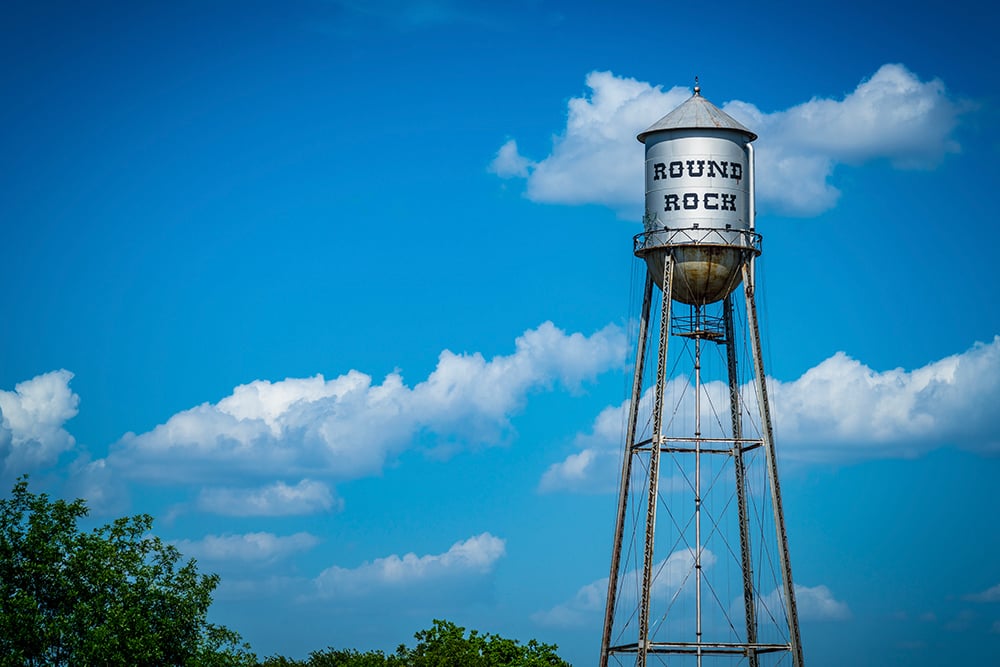
Drive past 1300 Louis Henna Boulevard in Round Rock and you'll see a fenced campus with no sign inviting you in. Until a few years ago, this was the old Sears Teleserv call center. Now it's a Sabey Data Centers campus, and later this year it's expected to start powering Horizon, the National Science Foundation's newest academic supercomputer, built for the University of Texas's Texas Advanced Computing Center. Almost nobody who lives in Round Rock will ever walk through its doors. Nearly everybody who owns a home here is touched by what it pays in property taxes.
That's the real story behind Round Rock's reputation for having one of the lower municipal tax rates in Central Texas. It's true, and it's not an accident. But the part of your tax bill that a data center can move is smaller than most buyers assume, and the part it can't touch is usually the biggest line on the page.
The math the city itself put on paper
Round Rock has been direct about why this matters. On its own data center information page, the city compares water and tax impact for the Sabey site against an equivalent residential footprint: 15 single-family homes with the same water usage would generate roughly $21,000 a year in city property tax. Sabey's campus, after its taxable value rose to about $210 million following redevelopment, generates roughly $800,000 a year in city property tax alone.
That gap is the whole logic of the strategy. Sabey's 2022 incentive agreement committed the company to at least $185 million in property improvements and $5 million in new equipment, in exchange for zoning approvals and a performance-based incentive package. The jobs created are modest by design, the agreement called for 20 primary positions over five years, because a data center isn't a jobs play. It's a tax base play. A commercial parcel that pays like 15 houses without needing 15 houses' worth of city services is, from a municipal budget standpoint, close to ideal.
This isn't Round Rock's first time running this strategy. The city has done it since it recruited Dell Technologies in the 1990s. Round Rock's economic development program now includes 26 active agreements that, excluding Dell, have generated $147 million in property and sales taxes with a net benefit to the city of $107 million. Include Dell's contribution and that net benefit climbs to $550 million. The taxable value created by these agreements totals $1.3 billion without Dell, or $1.921 billion with Dell folded in, which the city says represents almost 20 percent of its total commercial property value.
Horizon is simply the newest chapter. The supercomputer is part of a $457 million National Science Foundation initiative and is expected to deliver a tenfold improvement in simulation performance and a hundredfold jump in AI capability compared to TACC's current system. None of that changes your daily life directly. What it changes is who's picking up the tab for city services next to your subdivision.
What the low rate actually looks like on paper
The city's adopted rate for the fiscal year that runs through September 2026 is 37.2 cents per $100 of assessed value, applied against a median home value on the 2025 tax roll of $395,240. That's the number behind Round Rock's low-tax reputation, and it's real.
It's also moving. In mid-August 2026, City Council set a new maximum rate of 42.3 cents per $100 for the fiscal year that starts in October, an increase of just over 5 cents driven by additional fire department staffing and new facilities. City Chief Financial Officer Kevin Klosterboer told council that a homeowner with the median taxable value of $370,288 could see roughly $1,566 in annual city taxes under the new rate, up from what the lower rate would have produced.
| Line item | FY 2025-26 | Proposed FY 2026-27 |
|---|---|---|
| City tax rate (per $100) | $0.372 | $0.423 |
| Median taxable value cited | $395,240 (2025 roll) | $370,288 |
| Approximate annual city tax | roughly $1,470 | roughly $1,566 |
Even with the increase, this is still one of the lighter city-level rates in the region, and the reason is the same one that's been operating since Dell arrived. A wider commercial tax base means residential owners aren't the only ones covering the increase in fire staffing and facilities. But look at the table again. This is the city's slice. It is not your whole tax bill, and for most homeowners it isn't even the largest piece of it.
The line a data center can't discount
Round Rock ISD's certified rate runs close to $0.9450 per $100, more than double the city's rate on its own, and the school district portion typically makes up 50 to 60 percent of a total Central Texas tax bill. Sabey's campus and Dell's headquarters sit inside Round Rock's city limits and pay into the city's general fund. They don't automatically reduce what a school district needs to raise through its own rate, which is set separately and funds an entirely different set of obligations, from teacher salaries to bond debt on new campuses.
This is where "Round Rock has low taxes" stops being a citywide fact and starts depending on the specific address. Most of the city feeds into Round Rock ISD. But pockets in the northwest, including neighborhoods like Walsh Ranch and Mayfield Ranch, are zoned to Leander ISD instead, even though the mailing address still says Round Rock. Because the school portion is the largest line on the bill, two homes that are both, technically, "in Round Rock" can carry a meaningfully different total tax stack depending purely on which side of an attendance boundary they sit on. The city's commercial tax base doesn't reach across that line to even things out.
Put the two effects together and you get a more complete, and more useful, picture than the "Round Rock is cheap" shorthand. One broker's 2026 comparison using 2025 adopted rates found that a $600,000 home in the city of Austin carries roughly $12,300 a year in combined taxes, versus roughly $11,820 for a comparable home in Round Rock, a real but modest gap of about $480 a year. That's the city's commercial subsidy showing up in the total. It's a genuine advantage. It's also a few hundred dollars, not the dramatic swing some buyers expect when they hear "lowest tax rate in Central Texas."
Why this is worth checking right now
Round Rock's housing market has room to negotiate in ways it hasn't in years. Over the three months ending in June 2026, the median sale price ran around $373,000, down 5.6 percent from the same period a year earlier, with homes taking an average of 58 days to sell compared to 54 the year before. That kind of market gives a buyer time to actually do the homework instead of taking a citywide reputation at face value.
Before you compare two Round Rock listings on tax alone:
- Pull the tax certificate for each address through the title company, and look at every line, not just the city and county totals.
- Confirm the ISD by the specific parcel, not by the city name on the listing. Round Rock ISD and Leander ISD both reach into the city, and the boundary can run down a single street.
- Check for a Municipal Utility District. New construction in parts of Williamson County carries MUD rates on top of the standard stack, and that line doesn't show up until you ask for it specifically.
- Model your estimate using the proposed FY 2026-27 city rate, not last year's adopted rate, since the increase is already moving through council as of this writing.
- Ask what the school district portion funds in that specific attendance zone. A higher ISD rate sometimes reflects newer facilities or bond debt tied to recent growth, which is a different conversation than simply "which number is smaller."
A short FAQ
Does the data center boom mean my Round Rock taxes will go down? Not directly. It has helped keep the city's own rate lower than it would otherwise need to be, and the FY 2026-27 increase is smaller than it might have been without that commercial base. But the city rate is one line among several, and the largest line, the school district rate, isn't affected by a data center's tax bill.
Why did the city's rate go up this year if the commercial tax base is growing? The increase approved in August 2026 was tied to new fire department staffing and facility needs, not a shortfall in the commercial base. Growing cities add services, and services cost money even when the tax base is expanding.
How do I find out if a specific Round Rock address is zoned to Round Rock ISD or another district? Round Rock ISD publishes an interactive boundary map by address, and the Williamson Central Appraisal District's property search will list every taxing entity tied to a specific parcel, including the ISD, city, county, and any MUD. Always check the exact address rather than relying on the general reputation of the neighborhood.
Numbers like these are easier to read with someone who works this market address by address, not just citywide. If you're comparing Round Rock to a neighboring suburb, or comparing two Round Rock neighborhoods against each other, JBGoodwin Realtors can help you pull the actual tax certificate for the homes you're considering and walk through what each line means for your monthly payment before you write an offer.